Remote Work is the Default for Flexible Legal Talent in 2026
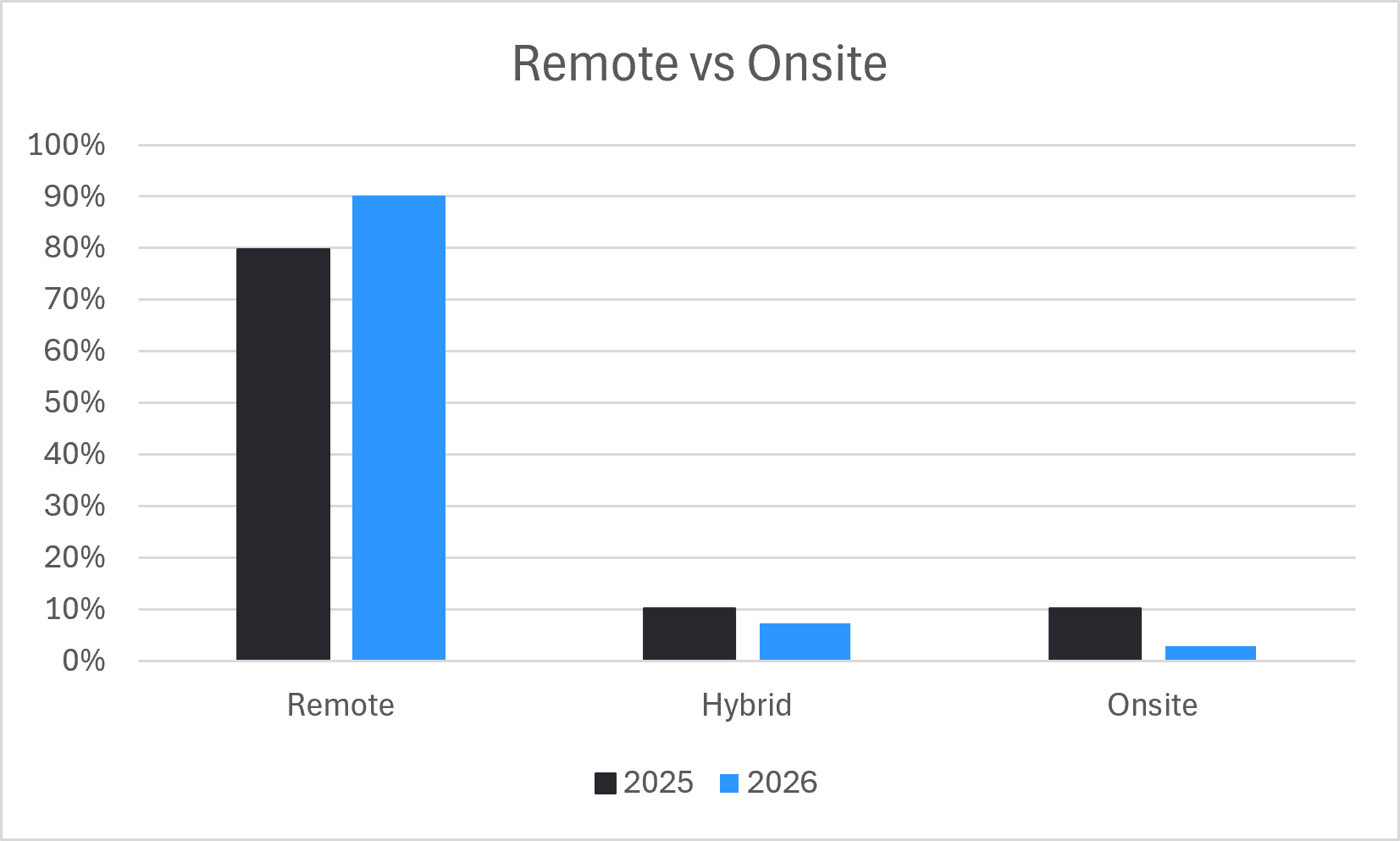
Despite the push in early 2025 to return to office, FLEX experienced a slight shift toward remote work this year. In 2025, about 80% of FLEX engagements were fully remote. The rest were split evenly between hybrid and remote engagements. In 2026 so far, about 90% of our engagements are fully remote. Hybrid engagements have fallen to 7% and onsite engagements are at about 3%. Many clients no longer treat remote work as a compromise. For most interim and fractional legal roles, it is the starting point.
The type of work may help explain why. Most of the demand in both years came from technology transactions, product counsel, privacy, and commercial contracting. These practice areas run on contract review, negotiation, and advisory work, all of which fit easily into distributed teams. In 2026 we're seeing more requests for AI product counsel, marketing and ad-tech attorneys, and interim general counsel roles. Clients filling these seats often care more about specialized expertise than where someone sits. When companies do ask for onsite or hybrid work, it's usually for a specific reason. Some senior roles want a regional presence in a major market like the Bay Area or New York. Others involve close, hands-on work with a business team.
How much time attorneys commit is also changing. Full-time engagements are still the most common, making up about two-thirds of 2025 placements and roughly 60% in 2026. Part-time setups are growing, though. These include two up to four days per week, hourly commitments, and roles that start full-time and scale down. More clients are also listing several acceptable schedules for a single role. That tells us companies are fitting legal support to their actual workload rather than defaulting to a full-time hire.
For attorneys, the takeaway is that the ability to work remotely effectively, along with deep subject-matter expertise, now matters more than location for most clients. For companies, remote engagements open a nationwide pool of specialized talent and allow flexible schedules that keep costs in line with need. We expect onsite requirements to stay the exception, used for situations where being physically present clearly adds value.